A thermal imaging camera for detecting floor leaks can help you find temperature patterns that point to hidden moisture, but it cannot confirm a leak by itself. I name the FOXWELL HT280 best overall for its high-resolution thermal imaging, while the Raythink EX10 Pro stands out for buyers who want a dual-lens setup and the FLIR TG165-X for straightforward, targeted checks. The main tradeoffs are image detail, ease of interpreting readings, portability, and how much diagnostic support comes with the device. A thermal camera can show where a floor differs in temperature, but plumbing tests or moisture measurements may still be needed to confirm the cause. Read on for the full comparison and a guide to choosing the right camera for your inspection needs.

Get cleaning gear delivered free with Prime
- Fast, free delivery on millions of items
- Prime Video, Amazon Music and more included
- Member-only deals all year
Complete the kit


Key Takeaways
- The FOXWELL HT280 leads this lineup for thermal detail, with a 260 × 260 TISR image specification that gives it an advantage when a floor pattern is subtle or covers a small area.
- Dual-lens designs serve a different purpose from thermal resolution alone: the Raythink EX10 Pro and HSFTOOLS HF96V pair thermal imaging with a visual camera, which can help relate a thermal anomaly to a recognizable floor feature.
- Thermal cameras reveal temperature patterns, not water itself; a warm pipe, underfloor heating, drafts, and changing room conditions can resemble a leak-related anomaly.
- Handheld models are better suited to room-by-room scanning, while the Thermal Master P1 and TOPDON TC004 Mini trade a dedicated camera body for a compact phone-connected format.
- Resolution is only one part of the choice: scene tools, visual context, operating convenience, and a plan to verify suspected moisture all affect how useful a camera will be on a real floor inspection.
| ITIPLINK Dual-Light Thermal Imaging Camera, 240 × 240 TISR |  | Best for Floor-Heating and Pipe Inspections | Infrared sensor: 96 × 96 | Enhanced resolution: 240 × 240 TISR | Thermal sensitivity: <40 mK | VIEW ON AMAZON | See Our Full Breakdown |
| GT16S Thermal Camera with AI Scene Detection and Thermometer Mode |  | Best for Lightweight Guided Scanning | Thermal sensor resolution: 128 × 128 | Enhanced display image: 240 × 240 | Inspection modes: Moisture, Insulation, Floor Heating, Electrical, Solar Panel | VIEW ON AMAZON | See Our Full Breakdown |
| FLIR TG165-X Thermal Imaging Camera with Bullseye Laser |  | Best for Simple, Rugged Spot Checks | Infrared resolution: 80 × 60 pixels | Temperature range: -25°C to 300°C (-13°F to 572°F) | Frame rate: 9 Hz or less | VIEW ON AMAZON | See Our Full Breakdown |
| Raythink EX10 Pro Dual-Lens Thermal Camera |  | Best for Detailed Floor-Leak Mapping | Thermal resolution: 320 × 240 | Thermal sensitivity: 40 mK | Display: 2.8 inches | VIEW ON AMAZON | See Our Full Breakdown |
| Thermal Master P1 USB-C Thermal Camera for iPhone and Android | 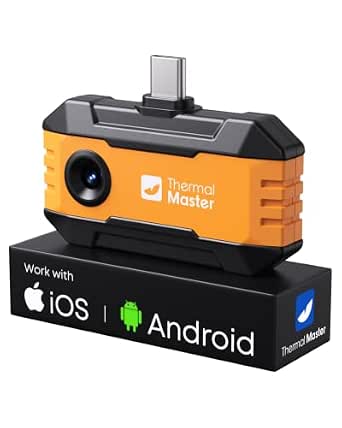 | Best Compact Phone-Based Pick | Connector: USB-C | IR resolution: 160 × 120 | Enhanced resolution: 320 × 240 | VIEW ON AMAZON | See Our Full Breakdown |
| TOPDON TC004 Thermal Imaging Camera |  | Best for Field Documentation | Infrared resolution: 256 × 192 | Enhanced resolution: Up to 512 × 384 with TISR | Display: 3.5 inches | VIEW ON AMAZON | See Our Full Breakdown |
| GT14S Thermal Imaging Camera with Thermometer Mode |  | Best Lightweight Pick | Weight: 240 g | Temperature range: -4°F to 1022°F | Thermal sensitivity: NETD < 50 mK | VIEW ON AMAZON | See Our Full Breakdown |
| FOXWELL RT280 Thermal Imaging Camera with 240 × 180 TISR Resolution |  | Best for Windows-Based Reporting | Enhanced thermal resolution: 240 × 180 with TISR | Display: Listed as 2.8 inches; product information also lists 4.3 inches | Frame rate: 25 Hz | VIEW ON AMAZON | See Our Full Breakdown |
| FOXWELL HT280 Thermal Imaging Camera, 320 × 240 LCD, 260 × 260 TISR |  | Best for Wide-Area Floor Scanning | Display: 2.8-inch, 320 × 240 LCD | Enhanced thermal resolution: 260 × 260 with TISR | Frame rate: 25 Hz | VIEW ON AMAZON | See Our Full Breakdown |
| HSFTOOLS HF96 Thermal Camera with AI Scene Detection and Laser Pointer |  | Best for Guided Leak Screening | Thermal image resolution: 240 × 240 | Temperature range: -4°F to 1022°F | Temperature accuracy: ±3.6°F | VIEW ON AMAZON | See Our Full Breakdown |
| HSFTOOLS HF96V Thermal Camera with Visual Camera and Laser Pointer |  | Best for Visual Cross-Checking | Thermal resolution: 96 × 96 pixels; enhanced up to 240 × 240 | Visual camera: 640 × 480 pixels | Temperature range: -4°F to 1022°F | VIEW ON AMAZON | See Our Full Breakdown |
| TOPDON TC004 Mini Thermal Imaging Camera |  | Best Compact Pick | Thermal resolution: 128 × 128 IR; enhanced to 240 × 240 with TISR | Refresh rate: 25 Hz | Field of view: 40° × 30° | VIEW ON AMAZON | See Our Full Breakdown |
| H128 Handheld Thermal Camera – 240×240 TISR Resolution, 24h Battery Life, 25Hz Infrared, Temperature Alarm, -4°F to 842°F, IP65 |  | Best for Long Inspection Days | Resolution: 240 × 240 TISR | Thermal sensitivity: 40 mK | Frame rate: 25 Hz | VIEW ON AMAZON | See Our Full Breakdown |
| Flagfront YXI96 Thermal Camera, 240 × 240 Resolution |  | Best for Broad Floor Scans | Resolution: 240 × 240 | Refresh rate: 25 Hz | Field of view: 50° | VIEW ON AMAZON | See Our Full Breakdown |
| AccuMEMS GT14S Thermal Imaging Camera with Edge Enhancement |  | Best Lightweight Manual-Control Pick | Temperature range: Description: -4°F to 1022°F; title states up to 1202°F | Field of view: 50° | Thermal sensitivity: NETD < 50 mK | VIEW ON AMAZON | See Our Full Breakdown |
| thermal imaging camera for detecting floor leak | Temperature range | Battery life | Field of view |
|---|---|---|---|
| ITIPLINK Dual-Light Thermal Im | -4°F to 1022°F | — | — |
| GT16S Thermal Camera with AI S | -4°F to 1202°F | Up to 11 hours | — |
| FLIR TG165-X Thermal Imaging C | -25°C to 300°C (-13°F to 572°F) | — | — |
| Raythink EX10 Pro Dual-Lens Th | -4°F to 1022°F | Up to 10 hours | — |
| Thermal Master P1 USB-C Therma | -4°F to 1112°F | — | 52° × 39° |
| TOPDON TC004 Thermal Imaging C | -4°F to 1022°F | Up to 8 hours | — |
| GT14S Thermal Imaging Camera w | -4°F to 1022°F | Up to 14 hours | 50° |
| FOXWELL RT280 Thermal Imaging | –4°F to 1022°F | — | 50° × 38° |
| FOXWELL HT280 Thermal Imaging | -10°C to 500°C (14°F to 932°F) | Up to 8 hours | 50° × 50° |
| HSFTOOLS HF96 Thermal Camera w | -4°F to 1022°F | Up to 11 hours | 50° |
| HSFTOOLS HF96V Thermal Camera | -4°F to 1022°F | Up to 11 hours | 50° |
| TOPDON TC004 Mini Thermal Imag | -4°F to 842°F | Up to 15 hours | 40° × 30° |
| H128 Handheld Thermal Camera | -4°F to 842°F | Up to 24 hours continuous | — |
| Flagfront YXI96 Thermal Camera | -4°F to 1022°F | — | 50° |
| AccuMEMS GT14S Thermal Imaging | Description: -4°F to 1022°F; title states up to 1202°F | Up to 14 hours | 50° |
More Details on Our Top Picks
ITIPLINK Dual-Light Thermal Imaging Camera, 240 × 240 TISR
I’d shortlist the ITIPLINK for homeowners and inspectors who want a camera with a dedicated floor-heating and water-pipe mode, rather than relying only on general thermal imaging. Dual-light fusion adds visible scene detail, which can help relate a warm or cool patch to the room around it, while temperature alerts and PC analysis with PDF export support documenting suspected leak patterns. Its 25 Hz refresh rate is a practical fit for scanning across a floor without the slower update feel of the FLIR TG165-X, which runs at 9 Hz or less.
The main qualification is resolution: the infrared sensor is 96 × 96, and 240 × 240 is enhanced TISR output, not native sensor detail. That makes it less suited to pinpointing small anomalies than the Raythink EX10 Pro’s 320 × 240 thermal sensor. I’d choose the ITIPLINK for guided, report-friendly home inspections, but not if native resolution is the priority.
Pros:- Dedicated floor-heating and water-pipe inspection modes help focus a scan on relevant building systems.
- Dual-light fusion adds visible context to thermal patterns.
- Temperature alerts, 8 GB storage, and PDF export support inspection records.
- IP54 protection, 6.6-foot drop resistance, and a built-in work light suit field use.
Cons:- The 96 × 96 infrared sensor provides less native detail than the Raythink EX10 Pro’s 320 × 240 sensor.
- The 240 × 240 figure is enhanced TISR resolution, not native infrared resolution.
Best for: Home inspectors and homeowners tracing suspected leaks around embedded floor-heating loops or water pipes who want guided modes and exportable reports.
Not ideal for: Technicians who need finer native thermal detail for small or closely spaced temperature anomalies; its sensor is 96 × 96 despite the enhanced 240 × 240 output.
- Infrared sensor:96 × 96
- Enhanced resolution:240 × 240 TISR
- Thermal sensitivity:<40 mK
- Refresh rate:25 Hz
- Temperature range:-4°F to 1022°F
- Storage:8 GB
- Battery:3200 mAh rechargeable lithium-ion
- Protection:IP54; 6.6-foot drop resistance
Our verdict“Choose the ITIPLINK if floor-heating presets and shareable inspection reports matter more than high native thermal resolution.”
GT16S Thermal Camera with AI Scene Detection and Thermometer Mode
The GT16S makes sense when I want a lightweight camera with floor-heating and moisture presets to help organize a first pass over a suspected leak. Its 0.5-pound body and stated battery life of up to 11 hours suit room-by-room scanning, while AI scene alerts and customizable temperature alarms can flag areas for closer inspection. The native 128 × 128 sensor is a step above the ITIPLINK’s 96 × 96 sensor, though its 240 × 240 display image is also enhanced rather than native.
Those prompts should be treated as leads, not a leak diagnosis: the supplied details describe alerts for suspected issues, not confirmation of water behind a floor. Compared with the Raythink EX10 Pro, the GT16S has lower native resolution but offers a very light format and longer stated runtime. I’d favor it for guided residential checks; buyers who need sharper thermal detail or clearer report workflows should look elsewhere.
Pros:- Five inspection modes include moisture and floor heating.
- Native 128 × 128 thermal sensor exceeds the ITIPLINK’s 96 × 96 sensor resolution.
- At 0.5 pounds, it is easy to carry during room-by-room checks.
- Up to 11 hours of stated battery life and customizable temperature alarms support extended scans.
Cons:- The 240 × 240 image is enhanced from a 128 × 128 sensor, not native resolution.
- AI alerts identify suspected issues and should not be treated as proof of a floor leak.
Best for: Homeowners or mobile inspectors who scan several rooms and want a lightweight camera with floor-heating and moisture presets.
Not ideal for: Users who need high native image detail or expect AI alerts to confirm a leak without follow-up inspection.
- Thermal sensor resolution:128 × 128
- Enhanced display image:240 × 240
- Inspection modes:Moisture, Insulation, Floor Heating, Electrical, Solar Panel
- Temperature range:-4°F to 1202°F
- Measurement accuracy:±2%
- Refresh rate:25 Hz
- Weight:0.5 lb
- Battery life:Up to 11 hours
Our verdict“Pick the GT16S for a light, guided first-pass inspection tool, but choose a higher-resolution camera when pinpoint detail is the priority.”
FLIR TG165-X Thermal Imaging Camera with Bullseye Laser
The FLIR TG165-X is a straightforward option for someone who needs to check a suspicious floor patch and record images, rather than run a highly detailed thermal survey. Its bullseye laser helps aim at a specific measurement area, while MSX enhancement combines visible detail with the thermal view to make saved images easier to interpret. The rugged IP54 enclosure and storage capacity for up to 50,000 images suit field work. Compared with the ITIPLINK, though, it has no listed floor-heating preset or PDF-report workflow.
For leak tracing, its biggest limitation is the combination of an 80 × 60 sensor and a frame rate of 9 Hz or less. That is less suited to quickly scanning broad floor areas or distinguishing small temperature changes than the Raythink EX10 Pro’s 320 × 240 sensor and the 25 Hz models in this group. I’d consider it for durable, targeted checks, but skip it for detailed mapping of an uncertain leak path.
Pros:- Bullseye laser helps direct temperature measurements to a chosen spot.
- MSX enhancement adds visible detail to thermal images.
- IP54-rated, drop-tested design is suited to work sites.
- Stores up to 50,000 images for inspection documentation.
Cons:- The 80 × 60 infrared resolution is substantially lower than the Raythink EX10 Pro’s 320 × 240.
- A frame rate of 9 Hz or less is less suited to quickly sweeping large floor areas.
- The listed features do not include a dedicated floor-heating mode or report-export workflow.
Best for: Tradespeople who need a rugged camera for occasional targeted checks and want a laser to help aim measurements.
Not ideal for: Inspectors mapping a broad or subtle floor-temperature pattern; the low-resolution sensor and 9 Hz-or-less frame rate limit scanning detail and smoothness.
- Infrared resolution:80 × 60 pixels
- Temperature range:-25°C to 300°C (-13°F to 572°F)
- Frame rate:9 Hz or less
- Response time:3 seconds
- Display:LCD
- Image storage:Up to 50,000 images
- Ingress protection:IP54
- Connectivity:USB
Our verdict“Choose the TG165-X for rugged, laser-aimed spot checks, not for detailed floor-leak mapping.”
Raythink EX10 Pro Dual-Lens Thermal Camera
For a buyer prioritizing thermal detail, the Raythink EX10 Pro is my strongest pick in this batch: its 320 × 240 thermal resolution gives it a clear advantage over the 96 × 96 ITIPLINK and the 128 × 128 GT16S when comparing temperature patterns across a floor. Four imaging modes, including fusion and picture-in-picture, pair thermal readings with visible context. Multiple measurement points and smart alarms can help locate and record areas that merit a closer plumbing investigation.
It is also more prepared for follow-up documentation than a simple spot-check camera, with wireless transfer, mobile-app support, and Windows PC software. The tradeoff is that its listed imaging modes are not the same as the GT16S’s named moisture and floor-heating presets, so it offers less guided setup. Its accuracy is stated as ±2°C or ±2%, and thermal imaging shows surface-temperature patterns rather than confirming water beneath the floor. I’d choose it for detailed comparative scans, not as a standalone leak detector.
Pros:- Native 320 × 240 thermal resolution offers more detail than the other handheld cameras in this batch.
- Thermal, visible, fusion, and picture-in-picture modes help connect hot or cool areas to floor features.
- Max, min, center, and six customizable measurement spots support comparative checks.
- Wireless transfer and PC software help organize and review inspection images.
Cons:- Does not list dedicated moisture or floor-heating inspection presets like the GT16S.
- Specified accuracy is ±2°C or ±2%, so small temperature differences should be interpreted cautiously.
Best for: Plumbing and building inspectors who want higher native thermal resolution, several measurement points, and connected image analysis for documenting floor scans.
Not ideal for: First-time users who want named moisture or floor-heating presets to guide setup, or anyone expecting a thermal camera alone to confirm a concealed leak.
- Thermal resolution:320 × 240
- Thermal sensitivity:40 mK
- Display:2.8 inches
- Visible-light camera:2 MP
- Imaging modes:Thermal, Visible, Fusion, Picture-in-Picture
- Temperature range:-4°F to 1022°F
- Measurement accuracy:±2°C or ±2%
- Battery life:Up to 10 hours
- Connectivity and protection:Wireless mobile app and Windows PC software; IP54; 6.6-foot drop resistance
Our verdict“Choose the EX10 Pro when native thermal detail and connected analysis matter more than guided leak-detection presets.”
Thermal Master P1 USB-C Thermal Camera for iPhone and Android
The Thermal Master P1 is the most compact approach here: instead of carrying a separate handheld camera, I can connect this USB-C thermal module to a compatible phone, tablet, or Windows device. Its 19-inch extension cable is useful for checking awkward edges or reaching under fixtures, and the 52° × 39° field of view covers a broad area in one view. The listed 160 × 120 sensor is higher than the ITIPLINK’s 96 × 96 sensor, while 320 × 240 is enhanced output rather than native resolution.
It records images and video, offers 1–15× zoom, and draws power from the connected device, so there is no separate camera battery to charge. That convenience comes with a dependency: compatibility and runtime rest on the host device, and the stated operating time varies with that device. Unlike the GT16S, the P1 does not list dedicated floor-heating or moisture modes. I’d pick it for phone-centered inspections and tight access, but not for buyers who want a self-contained tool.
Pros:- Compact USB-C design works with compatible phones, tablets, and Windows devices.
- 19-inch extension cable helps reach awkward inspection areas.
- A 160 × 120 infrared sensor and 52° × 39° field of view suit broad surface scans.
- Powered by the connected device, so it needs no separate battery charging.
Cons:- Requires a compatible USB-C host device and its runtime depends on that device.
- The 320 × 240 figure is enhanced resolution, not the native 160 × 120 sensor resolution.
- Does not list dedicated moisture or floor-heating inspection modes like the GT16S.
Best for: Inspectors and homeowners who already use a compatible USB-C phone or tablet and want a compact thermal camera with an extension cable for tight access.
Not ideal for: Buyers who need a standalone, ready-to-use camera or dedicated floor-heating and moisture presets; operation and runtime depend on the connected device.
- Connector:USB-C
- IR resolution:160 × 120
- Enhanced resolution:320 × 240
- Thermal sensitivity:0.04°C NETD
- Frame rate:25 Hz
- Temperature range:-4°F to 1112°F
- Field of view:52° × 39°
- Zoom and extension cable:1–15×; 19 inches
- Power and protection:Powered by connected device; 0.3 W consumption; IP54 water resistance; 1-meter drop protection
Our verdict“Choose the P1 for compact, phone-based scanning and hard-to-reach spots, provided you are comfortable relying on a compatible host device.”
TOPDON TC004 Thermal Imaging Camera
The TC004 suits leak inspections where documenting and sharing thermal patterns matters as much as finding them. Its 256 × 192 infrared resolution, enhanced to 512 × 384 with TISR, gives more image detail than the FOXWELL RT280’s 240 × 180 enhanced resolution on paper, while 64GB of storage leaves room for job records. Wi-Fi transfer can simplify moving files off the camera, and the laser pointer helps identify the area being measured. Those features are useful when comparing suspicious floor zones or sending findings to a plumber. The tradeoff is portability: at 2.11 pounds, it is heavier than the 240 g GT14S, and IP54 protection is for dust and splashes, not submersion. It detects surface-temperature patterns, not water or moisture directly.
Pros:- TISR enhancement raises the displayed thermal resolution to 512 × 384.
- 64GB storage and Wi-Fi support image archiving and transfer.
- Laser pointer helps identify the specific measurement target.
- IP54 protection and 2-meter drop resistance suit typical field handling.
Cons:- At 2.11 pounds, it may cause fatigue during extended handheld scanning.
- IP54 protection does not make the camera suitable for immersion or wet cleanup.
- Thermal imagery shows temperature differences, not moisture content or a confirmed leak.
Best for: Home inspectors and property-maintenance professionals who need to save and share thermal images from multiple floor-leak checks.
Not ideal for: Buyers prioritizing a lightweight camera for long handheld inspections, or anyone expecting a thermal camera to confirm moisture or locate a leak beneath every floor covering.
- Infrared resolution:256 × 192
- Enhanced resolution:Up to 512 × 384 with TISR
- Display:3.5 inches
- Temperature range:-4°F to 1022°F
- Storage:64GB
- Connectivity:Wi-Fi
- Battery life:Up to 8 hours
- Weight:2.11 pounds
- Drop resistance:2 meters
Our verdict“Choose the TC004 if you value detailed, shareable inspection records more than a lightweight camera.”
GT14S Thermal Imaging Camera with Thermometer Mode
For checking a suspected floor leak across several rooms, the GT14S puts less weight in your hand than the TOPDON TC004: it weighs 240 g and is rated for up to 14 hours of use. That combination makes it a practical choice for a long inspection route or occasional household checks. Its thermometer mode, adjustable high and low alarms, and stated NETD below 50 mK offer useful tools for spotting and tracking surface-temperature differences around floors. Compared with the FOXWELL RT280, however, the supplied details do not list image storage, file transfer, or analysis software, so it is less clearly suited to creating a documented inspection record. The listing also provides no infrared resolution or accuracy figure; buyers who need those specifics should favor a better-documented option. Like other thermal cameras here, it does not directly measure moisture.
Pros:- Lightweight 240 g body is easier to carry through a lengthy inspection.
- Up to 14 hours of battery life supports extended scanning sessions.
- Thermal imaging and thermometer modes offer different ways to inspect temperature patterns.
- Adjustable high and low temperature alarms can flag readings that cross set limits.
Cons:- The provided specifications do not state infrared image resolution or temperature accuracy.
- No storage, file-transfer, or reporting features are listed, unlike the FOXWELL RT280.
- Thermal patterns alone cannot confirm that a floor contains moisture or identify a leak source.
Best for: Homeowners or maintenance staff who want a light camera with long runtime for scanning multiple rooms without carrying a heavier inspection unit.
Not ideal for: Inspectors who need a specified image resolution, temperature accuracy, or built-in documentation and reporting workflow before purchasing.
- Weight:240 g
- Temperature range:-4°F to 1022°F
- Thermal sensitivity:NETD < 50 mK
- Detectable temperature difference:0.05°C
- Field of view:50°
- Color palettes:7
- Battery capacity:2500 mAh
- Battery life:Up to 14 hours
- Warranty:1 year
Our verdict“Pick the GT14S for lightweight, long-running household scans, but choose a more fully specified camera if image documentation is a priority.”
FOXWELL RT280 Thermal Imaging Camera with 240 × 180 TISR Resolution
The RT280 is a strong fit when a floor inspection needs to become a saved, reviewable report. Its 240 × 180 TISR-enhanced resolution and 25 Hz frame rate support scanning across a surface, while the included Windows PC analysis software adds a route from captured images to temperature analysis and reports. That makes it more documentation-focused than the lightweight GT14S, whose listed details do not include software or file storage. The RT280 also has high and low alerts, laser targeting, an LED light, and storage for over 20,000 images. There are caveats: the software is not compatible with Mac, and the product information conflicts on screen size, listing both 2.8 and 4.3 inches. Its IP54 rating and drop resistance help in field work, but it still cannot directly verify moisture beneath a floor.
Pros:- TISR-enhanced 240 × 180 resolution and 25 Hz frame rate support inspection scanning.
- Windows software provides image analysis and report-generation functions.
- Storage is listed for over 20,000 images.
- Laser targeting, LED light, IP54 protection, and drop resistance suit field inspections.
Cons:- The analysis software is not compatible with Mac.
- Product information gives conflicting display sizes of 2.8 and 4.3 inches.
- Thermal readings reveal surface-temperature variation but do not directly measure water or moisture.
Best for: Windows-using inspectors and building-maintenance teams who want thermal images that can be analyzed and assembled into reports.
Not ideal for: Mac users, or buyers who require unambiguous screen specifications and direct moisture measurement.
- Enhanced thermal resolution:240 × 180 with TISR
- Display:Listed as 2.8 inches; product information also lists 4.3 inches
- Frame rate:25 Hz
- Field of view:50° × 38°
- Temperature range:–4°F to 1022°F
- Temperature accuracy:±3.6°F / ±2%
- Storage:8 GB eMMC; over 20,000 images
- Connectivity and software:USB Type-C; Windows PC compatible, not Mac compatible
- Durability:IP54; withstands drops up to 6.6 feet
Our verdict“Choose the RT280 if Windows-based reporting is central to your floor inspections and the screen-size discrepancy is acceptable.”
FOXWELL HT280 Thermal Imaging Camera, 320 × 240 LCD, 260 × 260 TISR
The HT280’s 50° × 50° field of view is its clearest advantage for floor-leak searches: it covers a broader area than the RT280’s listed 50° × 38° view, which can make room-by-room sweeps more convenient. Its 260 × 260 TISR-enhanced resolution, 25 Hz imaging, and nine palettes give users ways to examine and interpret thermal patterns. Automatic high, center, and low readings plus alarms help flag areas for a closer check. Like the RT280, it can store over 20,000 images or videos and includes Windows analysis and reporting software, but Mac users are excluded. Runtime is up to eight hours, shorter than the GT14S’s stated 14 hours. The 6.6-foot drop rating and IP54 protection suit field handling, though neither makes it waterproof. It cannot confirm moisture directly, and its tripod is not included.
Pros:- 50° × 50° field of view covers a broader area than the RT280’s listed 50° × 38° view.
- TISR-enhanced 260 × 260 resolution and 25 Hz imaging support thermal inspection.
- Stores over 20,000 images or videos and supports Windows analysis and report generation.
- Temperature alarms, IP54 protection, and a 6.6-foot drop rating support field use.
Cons:- Windows software is not compatible with Mac.
- Up to 8 hours of battery life is shorter than the GT14S’s listed 14 hours.
- A tripod is not included, and the camera does not provide moisture readings.
Best for: Inspectors who scan broad floor areas and want a wide field of view, saved thermal files, and Windows-based analysis.
Not ideal for: Mac users, buyers needing more than an eight-hour listed runtime, or anyone who expects a camera to measure moisture directly.
- Display:2.8-inch, 320 × 240 LCD
- Enhanced thermal resolution:260 × 260 with TISR
- Frame rate:25 Hz
- Field of view:50° × 50°
- Temperature range:-10°C to 500°C (14°F to 932°F)
- Temperature accuracy:±3.6°F or ±2%
- Storage:Over 20,000 images or videos
- Battery life:Up to 8 hours
- Durability:IP54; 6.6-foot drop rating
Our verdict“Choose the HT280 for broad floor scans and Windows-based documentation, provided its runtime and platform limits suit your workflow.”
HSFTOOLS HF96 Thermal Camera with AI Scene Detection and Laser Pointer
The HF96’s AI scene detection gives it a distinct role for buyers who want help screening household or building surfaces for possible leak patterns. Paired with a thermometer, laser pointer, adjustable alarms, and Windows analysis software, it offers more inspection guidance than the GT14S, whose supplied specifications do not list AI detection or reporting tools. Its 240 × 240 thermal image resolution, below-50 mK sensitivity, and 25 Hz refresh rate provide useful context for spotting temperature contrasts across a floor. But this is still a screening tool: the product explicitly does not provide moisture readings, so a thermal anomaly is not proof of a leak. The stated ±3.6°F accuracy also limits confidence in fine temperature distinctions. With up to 11 hours of battery life and IP54 protection, it is better equipped for extended field checks than a quick spot-only tool, though storage is 4GB.
Pros:- AI scene detection is intended to help identify possible leaks and insulation gaps.
- Combines thermal imaging, thermometer functions, and a laser pointer.
- 240 × 240 resolution, adjustable alarms, and Windows analysis support inspection work.
- Up to 11 hours of runtime and IP54 protection suit extended field checks.
Cons:- Does not provide moisture readings, so thermal patterns cannot confirm a leak.
- Stated temperature accuracy is ±3.6°F.
- Windows analysis software is not listed as Mac-compatible, and storage is 4GB.
Best for: Home inspectors and maintenance staff who want AI-assisted thermal screening, alarms, and Windows analysis for suspected floor or building leaks.
Not ideal for: Buyers who need direct moisture confirmation, tighter stated temperature accuracy, or compatibility with Mac analysis software.
- Thermal image resolution:240 × 240
- Temperature range:-4°F to 1022°F
- Temperature accuracy:±3.6°F
- Thermal sensitivity:Below 50 mK
- Refresh rate:25 Hz
- Field of view:50°
- Battery life:Up to 11 hours
- Storage:4 GB
- Weight:1.46 pounds
Our verdict“Choose the HF96 for AI-assisted leak screening and Windows-based analysis, but pair its thermal findings with a moisture meter or other confirmation method.”
HSFTOOLS HF96V Thermal Camera with Visual Camera and Laser Pointer
For tracing a suspected leak beneath flooring, the HF96V’s strongest advantage is its 640 × 480 visual camera alongside thermal imaging. Its visual, thermal, and fusion views can help connect a temperature anomaly to a visible floor feature, while scene recognition may flag water leaks or insulation gaps. Compared with the TOPDON TC004 Mini, this model provides more ways to cross-check an area and a laser pointer to mark the spot, but its native thermal resolution is only 96 × 96 pixels; the advertised 240 × 240 view uses enhancement. That limits fine detail across a broad floor. The 11-hour battery and internal storage suit longer inspections, though the stated ±3.6°F accuracy makes it better for finding patterns than confirming exact temperatures.
Pros:- Visual, thermal, and fusion modes help relate a heat pattern to visible floor details.
- Scene recognition can identify possible leaks and insulation gaps.
- Laser pointer and adjustable temperature alarms support locating and revisiting suspect areas.
- Up to 11 hours of battery life and built-in storage for images and video.
Cons:- Native thermal resolution is 96 × 96; 240 × 240 depends on image enhancement.
- Specified temperature accuracy is ±3.6°F, limiting confidence in precise readings.
- At 1.32 pounds, it is heavier than the TOPDON TC004 Mini.
Best for: Home inspectors or maintenance staff who want a visual reference and multiple viewing modes when checking suspected leaks around floors and walls.
Not ideal for: Buyers prioritizing higher native thermal detail for scanning large floor areas; the 96 × 96 sensor is less suited to pinpointing small anomalies.
- Thermal resolution:96 × 96 pixels; enhanced up to 240 × 240
- Visual camera:640 × 480 pixels
- Temperature range:-4°F to 1022°F
- Temperature accuracy:±3.6°F
- Field of view:50°
- Frame rate:25 Hz
- Battery life:Up to 11 hours
- Storage:4 GB; over 30,000 images and up to 14 hours of video
Our verdict“Choose the HF96V if visual cross-checking matters more than high native thermal resolution.”
TOPDON TC004 Mini Thermal Imaging Camera
The TC004 Mini is a practical choice for quick checks in rooms where carrying a larger inspection tool is inconvenient. Its 128 × 128 infrared imaging gives it more native pixels than the HSFTOOLS HF96V, while TISR enhancement raises the displayed resolution to 240 × 240. For floor-leak searches, temperature alerts that can automatically capture photos help preserve suspicious readings as you move between rooms. The tradeoff is a 40° × 30° field of view, narrower than the HF96V’s 50° view, so each scan covers less floor. It also stores up to 8,000 photos in 512 MB, rather than the HF96V’s larger built-in storage. Its 15-hour runtime and compact, drop-resistant body suit mobile inspections, but the charging head is not included.
Pros:- 128 × 128 native thermal imaging, with TISR enhancement to 240 × 240.
- Temperature alerts can automatically capture photos of suspect areas.
- Up to 15 hours of runtime in a compact, IP54-rated body.
- Drop resistance up to 2 meters supports regular transport between inspection sites.
Cons:- The 40° × 30° field of view scans less area at once than the HF96V’s 50° view.
- 512 MB storage holds up to 8,000 photos, less than the HF96V’s 4 GB.
- Charging head is not included.
Best for: Plumbers, property managers, or homeowners who want a compact camera for occasional room-to-room floor checks and saved alert images.
Not ideal for: Inspectors who need a wide view to scan broad floor areas quickly or who require extensive onboard image storage.
- Thermal resolution:128 × 128 IR; enhanced to 240 × 240 with TISR
- Refresh rate:25 Hz
- Field of view:40° × 30°
- Temperature range:-4°F to 842°F
- Accuracy:±3.6°F / 2%
- Storage:512 MB eMMC; up to 8,000 photos
- Battery life:Up to 15 hours
- Durability:IP54; drop-resistant up to 2 meters
Our verdict“Pick the TC004 Mini for portable inspections and long runtime, provided its narrower view and limited storage fit your workflow.”
H128 Handheld Thermal Camera – 240×240 TISR Resolution, 24h Battery Life, 25Hz Infrared, Temperature Alarm, -4°F to 842°F, IP65
The H128 stands out when a leak hunt may stretch across a full workday: its stated 24-hour battery life is the longest among these five options. Its 240 × 240 TISR imaging, 40 mK sensitivity, and 25 Hz frame rate provide a stronger set of listed thermal details than the HF96V’s 96 × 96 base sensor, which may help when comparing temperature patterns across a floor. An alarm can draw attention to readings outside a set range, while IP65 protection and drop resistance suit rougher job sites. Unlike the HF96V, however, the H128 has no listed visual camera or fusion mode, so it offers less help tying a thermal patch to a visible feature. Its accuracy is specified as ±3%, and the temperature range ends at 842°F.
Pros:- 240 × 240 TISR imaging and 40 mK sensitivity provide useful thermal detail.
- Stated continuous battery life of up to 24 hours supports extended inspection days.
- IP65-rated construction and 6.56-foot drop resistance suit tougher work settings.
- 25 Hz frame rate and temperature alarm support scanning and spotting unusual readings.
Cons:- No visual camera or fusion viewing mode is listed, unlike the HSFTOOLS HF96V.
- Temperature accuracy is specified as ±3%, rather than a fixed degree tolerance.
- Its upper temperature limit is 842°F, below the HF96V’s 1022°F.
Best for: Plumbing and building-maintenance crews who need a dedicated thermal camera for extended inspections without frequent charging.
Not ideal for: Buyers who need a visual-light reference image, fusion overlays, or the wider temperature range listed for the HSFTOOLS HF96V.
- Resolution:240 × 240 TISR
- Thermal sensitivity:40 mK
- Frame rate:25 Hz
- Battery life:Up to 24 hours continuous
- Temperature range:-4°F to 842°F
- Temperature accuracy:±3%
- Drop resistance:6.56 feet
Our verdict“Choose the H128 if long runtime and rugged protection matter more than visual cross-checking or a wider temperature range.”
Flagfront YXI96 Thermal Camera, 240 × 240 Resolution
The YXI96 pairs a 50° field of view with 240 × 240 imaging, making it a sensible fit for scanning a larger stretch of floor without moving the camera as often. That wider view matches the HF96V’s field of view, while the Flagfront lists 240 × 240 resolution instead of the HF96V’s 96 × 96 base sensor. Its high and low temperature alarms plus on-screen high, low, and center readings give an inspector several ways to notice an unusual patch. The stated temperature range also extends to 1022°F, like the HF96V. The tradeoff is less documentation detail: unlike the HF96V, no visual camera or image-storage capacity is specified here. The listing says indoor use, so I would not select it for outdoor leak checks, and the claimed six palettes are not all named.
Pros:- 240 × 240 resolution and a 50° field of view suit broad indoor scans.
- High and low temperature alarms can flag readings outside chosen limits.
- On-screen high, low, and center readings support quick comparison across a scene.
- IP54 protection and 6.6-foot drop resistance help with routine job-site handling.
Cons:- No visual camera or image and video storage capacity is specified, unlike the HF96V.
- The listing specifies indoor use, limiting confidence for outdoor inspections.
- Six palettes are claimed, but only five are named in the product data.
Best for: Indoor inspectors who want a wide field of view and 240 × 240 thermal imaging for scanning floors and comparing hot and cold spots.
Not ideal for: Buyers who need a visual image alongside thermal readings, defined image storage, or a camera specified for outdoor use.
- Resolution:240 × 240
- Refresh rate:25 Hz
- Field of view:50°
- Temperature range:-4°F to 1022°F
- Temperature accuracy:Within 2%
- Color palettes:6 listed; five named in the product data
- Drop resistance:6.6 feet
Our verdict“Pick the YXI96 for wide indoor floor scans if visual documentation and clearly specified storage are not priorities.”
AccuMEMS GT14S Thermal Imaging Camera with Edge Enhancement
For buyers who prefer to adjust readings and settings themselves, the AccuMEMS GT14S offers adjustable emissivity and distance, spot temperature readings, and a full-screen thermal view. Those controls can help tailor measurements to different flooring surfaces, though a thermal camera still identifies temperature patterns rather than confirming a leak on its own. At 240 g, it is lighter than the 1.32-pound HF96V, making it easier to carry between rooms. The GT14S also lists a 50° field of view and up to 14 hours of battery life, but unlike the H128 it has no stated 240 × 240 resolution or IP65 rating in the supplied specifications. There is also conflicting range information in the listing: its description says 1022°F, while its title says 1202°F. I would verify that limit before purchase.
Pros:- Adjustable emissivity and distance settings offer control across different inspection surfaces.
- Spot readings and full-screen thermal imaging support both targeted checks and wider scans.
- At 240 g, it is lighter than the HSFTOOLS HF96V.
- Up to 14 hours of battery life and seven color palettes support extended use and image adjustment.
Cons:- The product data conflicts on maximum temperature: 1022°F in the description and 1202°F in the title.
- No thermal resolution or ingress-protection rating is specified in the supplied data.
- A 1-year warranty is listed, but the supplied product data gives limited detail on storage or image documentation.
Best for: Inspectors who want a lightweight handheld with adjustable measurement settings and both spot and full-screen temperature views.
Not ideal for: Buyers who need a clearly verified upper temperature limit, a documented high-resolution sensor, or a stated ruggedness rating.
- Temperature range:Description: -4°F to 1022°F; title states up to 1202°F
- Field of view:50°
- Thermal sensitivity:NETD < 50 mK
- Image frequency:25 Hz
- Temperature detection:Differences as small as 0.05°C
- Color palettes:7
- Battery life:Up to 14 hours
- Weight:240 g
Our verdict“Choose the GT14S for a light, adjustable handheld, but confirm its temperature range and resolution before relying on it for a defined inspection workflow.”

How We Picked
I ranked these cameras for the specific task of tracing possible floor leaks, not for general electrical or mechanical troubleshooting. I gave the most weight to thermal image detail, since clearer patterns can make it easier to distinguish a small anomaly from the surrounding floor. I also looked at visual context, scene and temperature tools, device format, and the practical value of features such as a laser pointer or a separate visual camera. Those features can help with aiming or interpreting a scan, but they do not prove that water is present.
The FOXWELL HT280 takes the lead on its stated thermal resolution, while the Raythink EX10 Pro earns attention for its dual-lens approach. The FLIR TG165-X is placed as a practical targeted-inspection option rather than a resolution leader. Compact phone-connected models rank lower for longer scanning sessions, though they may suit occasional use. Where product details do not establish a clear advantage for floor-leak work, I treat the model as a task-specific alternative rather than assuming that a similar name or feature set means equal performance.
| thermal imaging camera for detecting floor leak | Battery life |
|---|---|
| ITIPLINK Dual-Light Thermal Im | — |
| GT16S Thermal Camera with AI S | Up to 11 hours |
| FLIR TG165-X Thermal Imaging C | — |
| Raythink EX10 Pro Dual-Lens Th | Up to 10 hours |
| Thermal Master P1 USB-C Therma | — |
| TOPDON TC004 Thermal Imaging C | Up to 8 hours |
| GT14S Thermal Imaging Camera w | Up to 14 hours |
| FOXWELL RT280 Thermal Imaging | — |
| FOXWELL HT280 Thermal Imaging | Up to 8 hours |
| HSFTOOLS HF96 Thermal Camera w | Up to 11 hours |
| HSFTOOLS HF96V Thermal Camera | Up to 11 hours |
| TOPDON TC004 Mini Thermal Imag | Up to 15 hours |
| H128 Handheld Thermal Camera | Up to 24 hours continuous |
| Flagfront YXI96 Thermal Camera | — |
| AccuMEMS GT14S Thermal Imaging | Up to 14 hours |
Factors to Consider When Choosing Thermal Imaging Camera For Detecting Floor Leaks
Choosing a camera is only one part of locating a hidden floor leak. I would match the device to the size of the area, the type of floor, and the way you plan to confirm a suspected problem. These factors help separate useful diagnostic equipment from a camera that merely produces an eye-catching heat map.
Prioritize usable thermal detail over headline resolution
Higher thermal image resolution can make a small temperature pattern easier to see, especially when scanning a large floor or comparing neighboring areas. It does not automatically mean the camera can identify a leak at a particular depth or through every floor material. A polished surface, thick carpet, and insulated underlay can all affect the pattern reaching the camera. Think about the size of the suspected area and how close you can safely scan before paying for more pixels. A broader, obvious anomaly may be easy to spot on a simpler camera, while a faint or localized pattern calls for more image detail. Avoid treating display resolution or image enhancement as a substitute for the sensor’s thermal resolution.
Plan for temperature conditions before scanning
A camera measures surface temperatures, so the timing and conditions of a scan can matter as much as the device. Underfloor heating, sunlight through windows, recently moved furniture, and a heating or cooling cycle can create misleading differences. If possible, scan when the room has had time to settle and compare the suspect floor with nearby areas made from the same material. A warm-water pipe may create a clear trace, while a slow leak with little temperature contrast may not. Do not interpret one colorful image as a diagnosis; repeat the scan under changed conditions when appropriate. For difficult cases, pairing the camera with a moisture meter or a plumbing pressure test can reduce guesswork.
Choose visual context for the way you document findings
A thermal image can show an unusual patch without making its exact location obvious later. A visual camera or image-combination feature may help connect that patch to a tile edge, cabinet, pipe route, or room landmark. This is particularly useful when several people need to review the inspection or when you must return to the same spot. A laser pointer can help aim at a target, but it does not make the thermal measurement more precise. If you only need to check one accessible area, a simpler display may be enough. For larger surveys, consider how easily you can save, label, and share images rather than judging the camera by screen appearance alone.
Match the form factor to the size of the job
A handheld camera is usually easier to use for repeated scans across multiple rooms because it has a dedicated grip, screen, and controls. A phone-connected model can be smaller and convenient for a quick check, but its usefulness depends on phone compatibility, connector access, and whether you are comfortable managing the app while scanning. A compact device can become awkward if you need to inspect a large floor systematically or hold a phone near the ground for an extended period. Check that your phone’s port and operating system are supported before choosing a plug-in camera. For occasional spot checks, portability may matter more than a larger screen. For contractors or frequent inspections, handling and image workflow deserve more weight.
Treat temperature tools as aids, not leak detectors
Thermometer modes, scene recognition, alarms, and pointers can make a camera easier to operate, but none directly confirms moisture behind a finished floor. A temperature alarm can draw attention to a contrast you might otherwise miss, yet it may also react to normal heating or cooling differences. Automated scene features may help organize a scan, but the operator still needs to interpret the surface and surrounding conditions. Before buying, ask whether the feature helps you collect a better comparison or simply adds convenience. If the goal is to locate a leak for repair, plan a second method to verify the suspected area. This prevents an unusual thermal pattern from becoming an unnecessary floor opening.
Decide when a premium camera earns its place
Paying more can make sense when you regularly inspect large areas, need clearer thermal images, or must share findings with clients or other trades. A dual-lens system may help with documentation, while a higher-resolution sensor can make patterns easier to inspect; those benefits matter less for a one-time household check. No camera removes the need for skill in reading thermal patterns or for follow-up confirmation. Set a practical threshold: if you will use the device repeatedly and the added detail improves decisions, a more capable model may justify the extra spend. If you need one quick screening scan, a simpler camera plus a moisture meter may be a better use of your budget. Also factor in phone compatibility, image storage, and any workflow limits before choosing based on specifications alone.
Frequently Asked Questions
Can a thermal camera confirm that there is a leak under my floor?
No. A thermal camera shows differences in surface temperature, which can be consistent with a leak but can also come from heating pipes, drafts, sunlight, or insulation changes. A suspected pattern is a reason to investigate, not proof of water. Compare the area with nearby flooring under similar conditions and repeat the scan if the pattern changes with heating or cooling. For confirmation, use a moisture meter or ask a plumbing professional about suitable leak tests.
Will a camera find a leak beneath tile, wood, or carpet?
It may show a surface temperature pattern associated with moisture beneath a floor, but results depend on the floor construction and temperature contrast. Tile, wood, carpet, underlay, and insulation affect how quickly heat reaches the visible surface. A camera does not see through the floor, and a leak that produces little surface change may be missed. Scan a wider area and compare similar floor sections rather than expecting a precise outline of the pipe or wet spot. If the surface gives no clear signal, another diagnostic method may be needed.
Is higher thermal resolution worth paying for when checking a small suspected leak?
More thermal detail can help reveal smaller or less distinct patterns, so it is useful when the suspected area is subtle or you need to inspect a broad floor carefully. It will not overcome poor temperature contrast, a thick insulating floor, or confusing room conditions. For a clear, localized anomaly, a less detailed camera may still be adequate for screening. Consider how often you will use the camera and whether you need to document fine patterns for someone else. Resolution should be weighed alongside image context, handling, and a way to confirm moisture.
Should I choose a phone-connected camera or a handheld model?
A phone-connected camera suits compact storage and occasional checks, provided it works with your phone and you are comfortable using its app. A handheld model is often easier to grip and view during longer scans or when checking several rooms. Phone compatibility is more than a connector question: operating-system support and app behavior can affect whether the device is usable for your setup. Think about how long each inspection will take and whether you need to save or share images. For regular work, a dedicated camera body may be more practical; for brief spot checks, a plug-in unit can be convenient.
What should I do after the camera shows an unusual floor temperature pattern?
First, check for ordinary sources such as underfloor heating, sunlight, appliances, drafts, or a recent change in room temperature. Record the location and compare it with nearby flooring of the same material, then scan again if conditions change. A thermal pattern alone does not tell you whether the cause is a leak or where the water is traveling. Use a moisture meter where suitable, review plumbing plans if available, or arrange a professional leak test before opening the floor. This step can prevent damage caused by acting on a false alarm.
Conclusion
For most buyers focused on floor-leak screening, I would choose the FOXWELL HT280 as the best overall because its stated thermal detail gives it the clearest advantage in this group. The best value depends on your inspection needs: the FLIR TG165-X is a practical pick for targeted checks, while buyers who want more scene assistance can compare the GT16S and HSFTOOLS HF96. For a best premium direction, consider the Raythink EX10 Pro if its dual-lens approach fits your documentation needs. The best option for beginners is a model with straightforward aiming and helpful scene tools, such as the FLIR TG165-X or GT16S. If portability is your main need, look at the Thermal Master P1 or TOPDON TC004 Mini; if you need visual context in a handheld camera, compare the Raythink EX10 Pro and HSFTOOLS HF96V. Whatever you choose, treat the image as a screening clue and verify suspected moisture before authorizing floor repairs.
Fall Picks

Philips Hue Essential Starter Kit with Bridge and 4 E26 Smart Bulbs
As an affiliate, we earn on qualifying purchases.