
TL;DR

Get cleaning gear delivered free — and shop member deals
- Fast, free delivery on millions of items
- Access to Prime Big Deal Days deals on October 6–7
- Prime Video, Amazon Music and more included
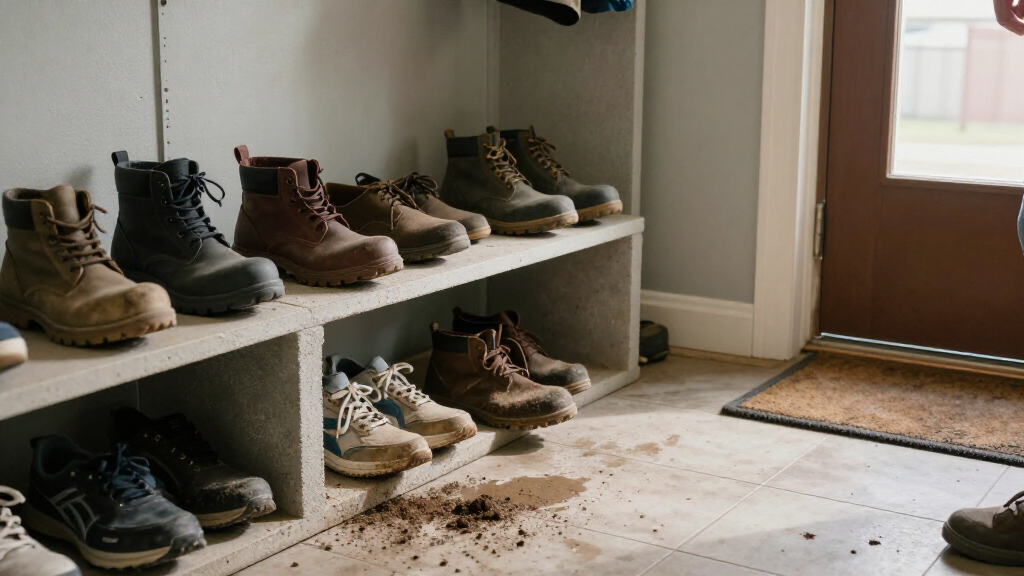
A Hunker report describes a DIY shoe-storage shelf made from six standard concrete blocks and three plywood boards, with paint or stain for a finished look. The design has three levels and can be assembled at home, but the report provides no tested weight capacity or safety certification.
Hunker has reported on a shoe-storage DIY shared by paint company BEHR that combines six concrete blocks and three plywood boards into a three-level shelf. The project offers a home-built alternative to a metal shoe rack, though the source does not provide a tested load limit or independent safety assessment.
The design uses six standard 8-by-8-by-16-inch concrete blocks and three matching pieces of plywood, each 16 inches wide. The boards’ length can vary according to the space and intended shelf size. Hunker says the blocks are commonly available building materials; its report cited a Home Depot price of less than $2 per block at the time of writing. That price is not a current quote, and availability may vary.
For the finish, the report suggests painting the blocks and staining the wood. It instructs readers to paint inside the blocks’ visible openings, sand rough plywood with fine-grit sandpaper, remove the dust and allow the materials to dry before assembly. The shelf is put together in the space where it will be used: a plywood board forms the base, with two blocks at each end supporting it. A second board rests across them, and the remaining blocks and board form the upper level.
Hunker says construction adhesive is optional in the project instructions, while describing the shelf as sturdy without it. That is the report’s characterization, not a published test result. The piece can hold shoes on its lower levels, while the upper board can serve as a surface for small household items. Bins or baskets can conceal footwear; the source also suggests a tension rod and short curtain as another way to cover shoes.
A Low-Cost Alternative With Limits
The proposal gives households a way to repurpose common building materials into entryway or bedroom storage, rather than buying a purpose-made metal rack. Its modular layout can be adjusted by changing the board length, and the exposed blocks and wood can be painted or stained to suit a room. Those features may appeal to people who already have spare materials or want a simple, visible storage project.
Cost claims need qualification. Hunker’s under-$2-per-block figure refers to a retailer price cited in the report, not a verified current total. The source does not state plywood prices, finishing costs, tool requirements or the overall project cost. The shelf also uses solid blocks, so its size and weight may make it less convenient to move than a lightweight rack. Readers should check that the intended location can accommodate the structure and that the assembled unit is stable before loading it.
As an affiliate, we earn on qualifying purchases.
How the Three-Level Design Fits Together
The project’s basic structure is a stack of boards supported by concrete blocks, not a permanently joined cabinet. The blocks sit in pairs at the ends of the lower board, with openings facing forward; another board rests across them. The remaining blocks sit at the ends of that board, with openings facing inward, and the final board goes on top. The openings can act as small storage spaces as well as part of the shelf’s appearance.
BEHR is identified in Hunker’s report as the source of the DIY idea. The report also names paint, stain and adhesive products as examples, but the supplied material does not establish that those brands or products are required. This is a home-storage suggestion, not a product recall, building-code update or independently tested furniture design.
“The report says the materials can be combined to create a durable furniture piece for shoes.”
— Hunker, describing the BEHR-shared project
Load Capacity and Stability Are Unspecified
The source gives no maximum weight, stability test or guidance on securing the shelf to a wall. It also does not specify plywood thickness, how much the boards may overhang, or whether the design is suitable for children to climb or pull on. The description of the shelf as sturdy should not be treated as a certified safety rating.
Other practical details are left open: the final dimensions depend on board length, and the report does not provide a complete cost estimate or instructions for preparing the floor and preventing movement. Readers considering the project should inspect the blocks and boards, assemble the unit on a level surface and avoid placing heavy or fragile items where a shift could cause them to fall.
Check Materials Before Assembly
The source describes a DIY option rather than a scheduled product launch or follow-up announcement, so no later milestone is identified. Anyone planning to build it will need to choose board lengths and finishes, prepare the materials, and decide whether the shelf’s size and weight suit the chosen location.
Before storing items on the shelf, check that the boards sit securely on the blocks and that the finished structure does not rock or slide. The report provides no formal load guidance, so readers should not assume a particular capacity. Current material prices and product availability should also be checked with local retailers rather than inferred from the historical prices cited in the article.
Key Questions
What materials does the shoe shelf use?
The described design uses six 8-by-8-by-16-inch concrete blocks and three plywood boards that are 16 inches wide. Board length is flexible, depending on the space and desired shelf size.
Does the project require construction adhesive?
No. Hunker describes adhesive as optional, but the report does not provide a test showing how securely the shelf performs with or without it.
How many levels does the shelf have?
The design has three board levels. Shoes can go on the lower levels, while the top can be used for small decorative or household items.
How much weight can the shelf hold?
The source does not give a load limit or an independent safety rating. It is not possible to confirm a specific safe weight from the supplied report.
Can the shoes be hidden?
Yes. Hunker suggests putting baskets or bins on the shelves, or using a tension rod and short curtain to cover footwear. These are optional additions, not part of the core block-and-board structure.
Source: rss
Halloween Picks
halloween
As an affiliate, we earn on qualifying purchases.