
TL;DR

Get cleaning gear delivered free with Prime
- Fast, free delivery on millions of items
- Prime Video, Amazon Music and more included
- Member-only deals all year
A Hunker report outlines a paper-template method for marking matching curtain-rod bracket positions on both sides of a window. The technique can reduce guesswork before drilling, but measurements and a level should still be used to check placement.
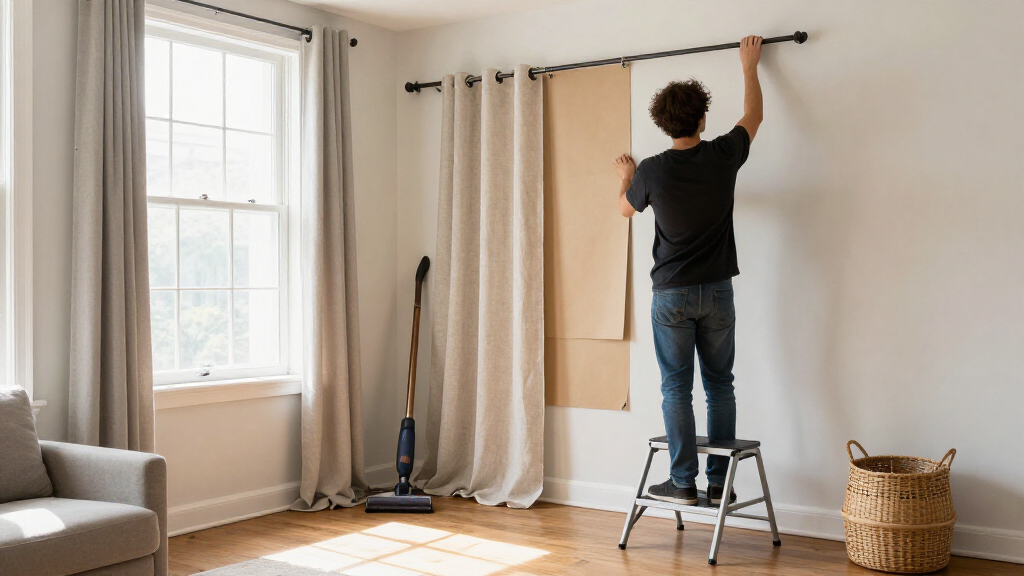
A paper-template method for lining up curtain-rod brackets has been highlighted in a Hunker report, which credits Instagram creator @stephanieboothhome with sharing the tip. The method uses paper aligned with the window trim to transfer screw-hole positions from one side of the window to the other before drilling.
The template is made by overlapping and taping two sheets of paper into a corner shape. One edge is aligned with the top of the window trim and another with the outer edge of the side trim. The bracket is positioned on the paper where it is intended to sit, and its screw holes are marked with a pencil. Small openings are then made in the paper at those marks.
To transfer the positions, the report says to flip the template and align it with the corresponding top and outside edges of the trim on the other side of the window. A pencil can then be used through the openings to mark the wall. The process is repeated at the original side before installing the brackets with appropriate hardware and hanging the rod.
Hunker lists a curtain rod and mounting hardware, paper, tape, a pencil and a drill among the supplies. It also recommends having a level and measuring tape nearby to check the layout. Wall anchors may be needed if the brackets are not being fastened into studs; the suitable fasteners depend on the wall and hardware.
Fewer Guesswork Marks on Walls
The practical appeal is that the paper acts as a reusable guide for matching bracket locations, rather than relying on repeated visual estimates. That may help people working alone transfer the same placement across a window and avoid making extra holes while adjusting a bracket.
The technique is a layout aid, not a guarantee that the rod will be level or that the brackets are correctly anchored. Checking measurements and using a level remain useful, and the wall material and mounting hardware still determine how the brackets should be secured. Readers should follow the hardware instructions and use a drill safely.
The same approach may also help plan other wall-mounted items. Hunker says a paper outline can be used for a picture frame or shelf: mark where its hanging hardware sits, tape the template to the wall, and adjust the paper’s position before making marks.
Products Worth Considering

Ring Alarm Pro 14-Piece Home Security Kit with Built-In eero Wi-Fi 6 Router

Philips Hue White and Color Ambiance Smart Light Starter Kit, 2 A19 Bulbs with Hub

Ring Alarm Pro 8-Piece Kit with Built-In eero Wi-Fi 6 Router
As an affiliate, we earn on qualifying purchases.
How the Paper Guide Transfers Marks
The challenge addressed by the tip is keeping two curtain-rod brackets at corresponding heights and distances from a window. The Hunker report describes using the trim edges as reference points, so the template can be flipped and repositioned on the opposite side rather than measuring each bracket placement independently.
The report attributes the method to Instagram creator @stephanieboothhome and presents it as a do-it-yourself tip. It does not provide test results or measurements comparing this approach with other installation methods. Its basic premise is the transfer of marked screw-hole locations through a paper guide.
Hunker also suggests keeping templates for later decorating projects. In practice, a saved template will only be useful again if the new item has the same hardware spacing and is being fitted to a suitably similar layout.
“The paper helps transfer the bracket placement from one side of the window to the other.”
— Hunker, describing the method shared by Instagram creator @stephanieboothhome
Limits of the Template Method
The supplied report does not specify the creator’s post date, provide a link to the original Instagram post, or give independent testing of the technique. It also does not state how much paper or tape is needed for different window sizes, or account for windows whose trim is uneven or not aligned with the desired rod position.
The template transfers marks, but the source does not establish that it will suit every bracket, wall surface or curtain setup. Exact bracket height and distance from the window, the right anchor or screw, and whether the chosen locations meet installation requirements depend on the project. The report does not include a specific rod-installation measurement standard.
Check the Marks Before Drilling
Before drilling, compare both marked positions with a measuring tape and use a level to check that the planned rod will sit correctly. Confirm that the brackets and fasteners are appropriate for the wall, and follow the product instructions. If a mark needs to move, adjust it before making holes.
After the brackets are installed, fit the rod and curtains according to their instructions and check that the setup is secure. The source provides a DIY procedure rather than a product launch or scheduled follow-up; it does not identify any further confirmed development.
Key Questions
How does the paper template help hang a curtain rod?
It records the bracket screw-hole positions on one side of the window, then transfers those marks to the other side by aligning the paper with the window trim.
What materials does the method use?
The Hunker report lists two sheets of paper, tape, a pencil, the curtain rod and its mounting hardware, and a drill. It recommends keeping a level and measuring tape nearby; wall anchors may be needed if the brackets are not fastened into studs.
Can the paper guide replace a level or measuring tape?
No. The report recommends both tools to double-check the marks. The template transfers positions, but does not confirm by itself that the rod will be level or correctly placed.
Can this method be used for pictures or shelves?
Hunker says a paper outline can help plan wall decor. Trace the item or mark its hanging hardware on paper, tape the template to the wall, and adjust its position before marking holes. Check that the hardware and wall fasteners suit the item.
Source: hunker.com