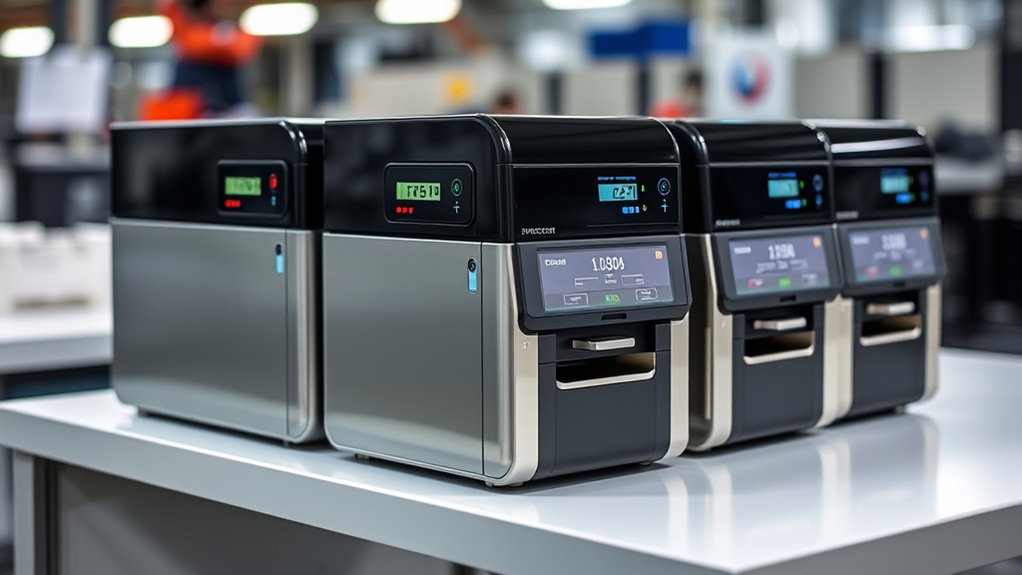

A digital barcode label printer deluxe can mean very different things: a compact Bluetooth label maker, a 4×6 shipping printer, or a desktop unit for repeat barcode work. My best overall pick is the iDPRT Thermal Label and Barcode Printer for buyers seeking a versatile desktop option, while the Phomemo M120 stands out for portable small-label printing and the AOBIO X4BT for 4×6 shipping labels. The main tradeoffs are label width, portability, setup and how well a printer fits your existing software and workflow. Read on for the full breakdown, including which options are better suited to specific workspaces and label jobs.

Get cleaning gear delivered free with Prime
- Fast, free delivery on millions of items
- Prime Video, Amazon Music and more included
- Member-only deals all year
Complete the kit


Key Takeaways
- The lineup splits by label job: the AOBIO X4BT and Labeer are 4×6 shipping-focused choices, while the 2-inch CLABEL models and Phomemo M120 suit narrower labels.
- Portability changes the use case: the Phomemo M120 and REEKON P1L are designed for mobile labeling, while desktop models favor a fixed work area.
- Bluetooth is not a universal advantage: it can simplify printing from a compatible mobile device, but buyers with established desktop workflows may prefer a printer that fits their computer and software setup.
- The CLABEL 221D name covers distinct versions: compare the Bluetooth and desktop listings carefully rather than assuming their connections and workflows are identical.
- The DYMO LabelWriter 450 Twin Turbo prioritizes a different workflow: its twin-roll desktop format may suit switching between label types, but it is less portable than the mobile-focused options.
| Phomemo M120 Bluetooth Thermal Label Maker |  | Best for Portable, Mixed-Use Labeling | Printer technology: Inkless thermal | Print output: Monochrome | Resolution: 203 × 203 DPI | VIEW ON AMAZON | See Our Full Breakdown |
| AOBIO X4BT 4×6 Bluetooth Thermal Shipping Label Printer |  | Best for 4×6 Shipping Labels | Printer technology: Thermal, monochrome | Resolution: 203 × 203 DPI | Print speed: Up to 152 mm/s | VIEW ON AMAZON | See Our Full Breakdown |
| CLABEL 221D 2-Inch Bluetooth Barcode Label Printer |  | Best for Item and QR-Code Labels | Printer technology: Direct thermal | Print resolution: 203 DPI | Label width: 25–50 mm | VIEW ON AMAZON | See Our Full Breakdown |
| iDPRT Thermal Label and Barcode Printer |  | Best for Flexible Desk Setup | Printer technology: Thermal | Print output: Monochrome | Resolution: 203 × 203 DPI | VIEW ON AMAZON | See Our Full Breakdown |
| Labeer Bluetooth Thermal Shipping Label Printer, 4×6 |  | Best for Multi-Size Shipping and Inventory | Printer technology: Direct thermal | Print output: Monochrome | Resolution: 203 × 203 DPI | VIEW ON AMAZON | See Our Full Breakdown |
| REEKON P1L Portable Bluetooth Construction Label Printer |  | Best for Jobsite QR Labels | Printer type: Construction tagger | Printing technology: Monochrome thermal | Connectivity: Bluetooth | VIEW ON AMAZON | See Our Full Breakdown |
| DYMO LabelWriter 450 Twin Turbo Direct Thermal Label Printer |  | Best for Switching Between Two Label Rolls | Printing technology: Direct thermal | Label rolls: Two | Compatible software: Microsoft Word, Excel, Outlook, and Google Contacts | VIEW ON AMAZON | See Our Full Breakdown |
| CLABEL 221D Desktop Thermal Barcode Label Printer, 2-Inch |  | Best for Template-Based Label Design | Printer type: Desktop thermal label printer | Maximum label width: 50 mm | Label height range: 15–150 mm | VIEW ON AMAZON | See Our Full Breakdown |
| CLABEL 2-Inch Desktop Bluetooth Barcode Label Printer |  | Best for Phone-and-PC Flexibility | Printer type: Direct thermal | Print resolution: 203 × 203 dpi | Print output: Monochrome | VIEW ON AMAZON | See Our Full Breakdown |
| digital bar code label printer deluxe | Connectivity | Printer technology |
|---|---|---|
| Phomemo M120 Bluetooth Thermal | Bluetooth and USB-C | Inkless thermal |
| AOBIO X4BT 4×6 Bluetooth Therm | Bluetooth for smartphones; USB for computers | Thermal, monochrome |
| CLABEL 221D 2-Inch Bluetooth B | USB and Bluetooth | Direct thermal |
| iDPRT Thermal Label and Barcod | Bluetooth and USB | Thermal |
| Labeer Bluetooth Thermal Shipp | Bluetooth and USB | Direct thermal |
| REEKON P1L Portable Bluetooth | Bluetooth | — |
| DYMO LabelWriter 450 Twin Turb | — | — |
| CLABEL 221D Desktop Thermal Ba | — | — |
| CLABEL 2-Inch Desktop Bluetoot | USB and Bluetooth | — |
More Details on Our Top Picks
Phomemo M120 Bluetooth Thermal Label Maker
The Phomemo M120 is the most flexible small-format pick here for buyers who need barcodes alongside QR codes, stickers, and occasional shipping labels. Its 20–50 mm label range and Print Master app templates suit stockrooms, craft tables, and mobile inventory work better than the shipping-focused AOBIO X4BT, which handles wider 4×6 labels. Bluetooth printing from iOS and Android keeps phone-based labeling convenient, while USB-C connects it to computers. The app’s OCR and voice recognition can speed up label creation, and inkless thermal printing removes ink and toner from the supply list. The tradeoff is monochrome output and a computer connection that requires USB rather than Bluetooth; choose another model if wide shipping labels are your main workload.
Pros:- Compact 235 g body is easy to carry between work areas
- Prints labels from 20–50 mm wide for varied small-format tasks
- Print Master offers templates, OCR, and voice recognition
- Inkless thermal printing avoids ink, toner, and ribbon supplies
Cons:- Monochrome output cannot produce color-coded labels
- Computer connections use USB-C rather than Bluetooth
- Its 50 mm maximum label width is narrower than the AOBIO X4BT’s shipping-label range
Best for: Small-business owners and makers who need a portable printer for item labels, QR codes, and short runs from a phone.
Not ideal for: High-volume shippers who mainly print 4×6 labels or buyers who want wireless computer printing.
- Printer technology:Inkless thermal
- Print output:Monochrome
- Resolution:203 × 203 DPI
- Label width:20–50 mm (0.8–2 in)
- Connectivity:Bluetooth and USB-C
- Compatible systems:iOS, Android, Windows, Mac OS, Chrome OS
- Weight and dimensions:235 g; 4.37 × 3.39 × 2.32 in
- Battery yield:3,000+ labels per charge
- Included labels:40 × 30 mm starter roll, 100 pieces
Our verdict“Choose the M120 for portable, phone-friendly barcode and item labeling, but pick the AOBIO X4BT for routine 4×6 shipping labels.”
AOBIO X4BT 4×6 Bluetooth Thermal Shipping Label Printer
For sellers whose barcode work mostly means shipping parcels, the AOBIO X4BT is the most direct fit in this group. Its 1.57–4.25-inch label support accommodates common 4×6 shipping stock, unlike the narrower Phomemo M120 and CLABEL 221D, which are better suited to item labels and tags. Bluetooth smartphone printing and USB computer connectivity cover the usual order-fulfillment setups, while a stated speed of up to 152 mm/s can help with batches. Thermal printing avoids ink and toner. The compromises are a required HereLabel app for phone printing and a compatibility exclusion for Surface tablets. It is less versatile for tiny, specialized inventory labels than the M120, but makes more sense when shipping-label width is the priority.
Pros:- Supports common shipping-label widths up to 4.25 inches
- Bluetooth smartphone printing and USB computer connection
- Print speed is listed at up to 152 mm/s
- Thermal output requires no ink or toner
Cons:- Smartphone printing requires the HereLabel app
- Surface tablets are excluded from stated computer compatibility
- Its shipping-focused width range is less suited to narrow item labels than the Phomemo M120
Best for: Online sellers and small fulfillment teams printing 4×6 shipping labels from phones or computers.
Not ideal for: Surface tablet users or shops focused on narrow product tags, QR labels, and other small-format stock.
- Printer technology:Thermal, monochrome
- Resolution:203 × 203 DPI
- Print speed:Up to 152 mm/s
- Supported label widths:1.57–4.25 in
- Connectivity:Bluetooth for smartphones; USB for computers
- Supported systems:Windows, macOS, Linux, Android, iOS
- Dimensions:4.3 × 6.9 × 3.7 in
- Included accessories:Power adapter, sample labels, USB cable, Type-C adapter, manual, USB driver stick
Our verdict“Pick the X4BT if your daily barcode workload is built around 4×6 parcel labels and app-based phone printing.”
CLABEL 221D 2-Inch Bluetooth Barcode Label Printer
The CLABEL 221D earns its place by keeping the job focused: printing barcodes, QR codes, tags, and small inventory labels on 25–50 mm thermal paper. Its saved layouts and free Clabel Trade templates make repeat batches easier to set up than the more shipping-oriented AOBIO X4BT, while USB for Windows PCs and Bluetooth for iOS and Android cover common small-business devices. It also works with universal compatible thermal paper without RFID chip restrictions, which gives buyers more choice in consumables. The boundary is clear, though: it is not for 4×6 shipping labels, receipts, tablets, or POS systems. Compared with the Phomemo M120, its stated uses are more tightly centered on barcode and tag workflows, with less detail provided about app tools and battery life.
Pros:- Prints 203 DPI barcodes, QR codes, tags, and stickers
- Bluetooth phone connection plus USB for Windows PCs
- Saved layouts and templates support repeat batch jobs
- Compatible thermal paper does not require RFID chip restrictions
Cons:- Cannot print 4×6 shipping labels or receipts
- Not compatible with tablets or POS systems
- Its 25–50 mm media range is narrower than the AOBIO X4BT’s shipping-label support
Best for: Retailers, makers, and stockroom teams who batch-print compact barcode, QR-code, and product-tag labels.
Not ideal for: Parcel shippers, POS operators, or buyers who need printing from a tablet or 4×6 labels.
- Printer technology:Direct thermal
- Print resolution:203 DPI
- Label width:25–50 mm
- Connectivity:USB and Bluetooth
- Compatible devices:Windows PCs, iOS phones, Android phones
- Design app:Clabel Trade
- Supported uses:Item labels, barcodes, QR codes, tags, stickers
- Not supported:4×6 shipping labels, receipts, tablets, POS systems
Our verdict“Choose the 221D for compact barcode and tag runs, not for parcel shipping or checkout-system printing.”
iDPRT Thermal Label and Barcode Printer
The iDPRT Thermal Label and Barcode Printer is a practical desktop choice when a buyer wants both Bluetooth and USB without committing to a shipping-only format. Its 1–3.15-inch media range reaches wider than the Phomemo M120’s compact rolls, while staying more focused on address labels, barcodes, and tags than the AOBIO X4BT’s 4×6 shipping range. Support for suitable thermal paper from various brands may make sourcing easier, and app-based design tools let users customize labels for different tasks. The listed speed of 140 pages per minute signals a high-throughput claim, though the product data does not clarify a direct label-per-minute comparison. It remains monochrome and depends on correctly sized thermal paper, so it is a less adaptable fit than models with more specific media guidance.
Pros:- Bluetooth and USB connectivity for phones and laptops
- Supports label widths from 1 to 3.15 inches
- Works with suitable thermal paper from various brands
- App tools allow customized address, barcode, and tag designs
Cons:- Monochrome printing cannot create color-coded labels
- Requires thermal paper in a compatible size
- The stated 140 pages-per-minute speed is not expressed as a label-per-minute rate
Best for: Small offices and workrooms that want a desk-based printer for barcode, address, and tag labels across compatible media.
Not ideal for: Buyers who need color output, a pocketable device, or clearly specified support for 4×6 shipping labels.
- Printer technology:Thermal
- Print output:Monochrome
- Resolution:203 × 203 DPI
- Print speed:140 pages per minute
- Supported label widths:1–3.15 in
- Connectivity:Bluetooth and USB
- Compatible devices:Laptops and smartphones
- Dimensions:8.11 × 6.1 × 5.28 in
Our verdict“Choose the iDPRT for a flexible desk setup across several label types, but look to the AOBIO X4BT for a clearly specified 4×6 shipping workflow.”
Labeer Bluetooth Thermal Shipping Label Printer, 4×6
The Labeer Bluetooth Thermal Shipping Label Printer stands out for buyers who need one machine to handle both parcel labels and smaller inventory formats. It supports 4×6, 4×4, 4×2, and 2×1-inch labels, plus custom sizes, giving it more stated format flexibility than the AOBIO X4BT. Automatic gap detection and calibration can reduce setup friction when switching compatible label stock. Its Bluetooth and USB options cover Windows, mobile devices, and several computer systems, though the connection details vary: macOS, ChromeOS, and Linux are listed as USB-compatible, while mobile printing uses the FlashLabel Pro app. At 450 g, it is not as light as the Phomemo M120, and its maximum sheet capacity is 50. This is the stronger fit for mixed shipping and stockroom tasks, not pocket-sized portability.
Pros:- Supports common shipping formats plus 2×1-inch and custom labels
- Automatic gap detection and calibration help when loading labels
- Bluetooth and USB connectivity across listed computer and mobile systems
- Direct thermal printing avoids ink, toner, and ribbons
Cons:- Mobile printing requires the FlashLabel Pro app
- macOS, ChromeOS, and Linux are listed as USB-compatible
- At 450 g, it is less portable than the Phomemo M120
Best for: Small online retailers that print 4×6 parcel labels as well as smaller barcode and inventory labels on one printer.
Not ideal for: Users who want a lightweight carry-anywhere label maker or prefer mobile printing without a dedicated app.
- Printer technology:Direct thermal
- Print output:Monochrome
- Resolution:203 × 203 DPI
- Supported label widths:1.57–4.41 in
- Supported label sizes:4×6, 4×4, 4×2, 2×1 in, and custom sizes
- Connectivity:Bluetooth and USB
- Compatible systems:Windows, macOS, ChromeOS, Linux, iPhone, Android
- Dimensions and weight:7.2 × 2.64 × 3.15 in; 450 g
- Maximum sheet capacity:50
Our verdict“Pick the Labeer if you need one printer for parcel shipping and smaller inventory labels, and can work within its app and connection requirements.”
REEKON P1L Portable Bluetooth Construction Label Printer
The REEKON P1L is the most jobsite-focused pick here: its battery power, rugged case, and mounting clip suit crews who need labels away from a desk. Through the BOLDR Pro app, it makes custom labels and QR codes with a one-click workflow, while its tear-resistant adhesive labels are designed to handle dust, moisture, and temperature changes. That makes it a better fit for tool, material, and equipment identification than the desktop-oriented CLABEL 221D, which offers more label-design options but less emphasis on mobile construction use. The tradeoff is a monochrome-only printout and dependence on the BOLDR Pro app; buyers wanting a general office label workflow may find the DYMO LabelWriter 450 Twin Turbo more suitable. Its compact size helps on site, though a 10-label maximum sheet capacity limits how much it can stage at once.
Pros:- Battery-powered design supports labeling away from an outlet
- BOLDR Pro app provides one-click custom labels and QR codes
- Rugged case and mounting clip suit jobsite handling
- Adhesive thermal labels are designed to withstand dust, moisture, and temperature changes
Cons:- Prints in monochrome only
- Requires the BOLDR Pro app to print
- Maximum sheet capacity is 10
Best for: Construction crews and site managers who need portable, durable QR and identification labels for tools, materials, or equipment.
Not ideal for: Office users who need broad software flexibility, color output, or large batches prepared without relying on a dedicated phone app.
- Printer type:Construction tagger
- Printing technology:Monochrome thermal
- Connectivity:Bluetooth
- App control:BOLDR Pro app
- Power:Battery-powered
- Charging port:USB Type-C
- Weight:1.4 pounds
- Dimensions:5.6 x 4.1 x 3 inches
- Label features:Customizable, tear-resistant adhesive thermal labels
Our verdict“Choose the REEKON P1L for portable, jobsite-ready QR labels, but pick a desktop model for broader everyday office labeling.”
DYMO LabelWriter 450 Twin Turbo Direct Thermal Label Printer
The DYMO LabelWriter 450 Twin Turbo earns its place for users who regularly alternate between two label formats. Its dual-roll setup avoids the pause of removing one roll and loading another, a practical advantage over the single-format emphasis of the CLABEL 221D. Direct thermal printing also means no ink or toner, and printing precise quantities can reduce unused sheet labels. Its links to Microsoft Word, Excel, Outlook, and Google Contacts make it a natural fit for contact, office, and address labels. Compared with the REEKON P1L, this is a desk-based workflow rather than a portable jobsite tool: the P1L brings battery power and rugged construction features, while the DYMO prioritizes familiar computer applications and roll switching. The supplied details do not specify device connectivity, print dimensions, or speed, so buyers needing those details before choosing should verify compatibility and requirements.
Pros:- Holds two label rolls for convenient switching
- Direct thermal printing requires no ink or toner
- Prints precise quantities without sheet-label waste
- Supports label printing from Microsoft Word, Excel, Outlook, and Google Contacts
Cons:- The supplied product details do not specify connectivity options
- The supplied product details do not state print speed or label dimensions
- Requires compatible LabelWriter rolls, with authentic DYMO labels recommended
Best for: Small offices or home businesses that print from contact lists and frequently switch between two label rolls.
Not ideal for: Construction crews or mobile users who need a battery-powered printer, rugged handling, or clearly specified Bluetooth connectivity.
- Printing technology:Direct thermal
- Label rolls:Two
- Compatible software:Microsoft Word, Excel, Outlook, and Google Contacts
- Recommended labels:Authentic DYMO LabelWriter labels
- Ink or toner:Not required
- Printing method:Prints precise quantities of labels
Our verdict“Pick the DYMO Twin Turbo if office convenience and switching between two rolls matter more than portability or jobsite durability.”
CLABEL 221D Desktop Thermal Barcode Label Printer, 2-Inch
The CLABEL 221D suits buyers who want a compact desktop printer with room to shape the label design. Its app includes 58 templates, 11 font styles, and over 300 icons, alongside support for barcodes, QR codes, text, images, tables, and graphs. That makes it more design-oriented than the DYMO LabelWriter 450 Twin Turbo, whose standout advantage is switching between two rolls and printing from familiar office applications. The CLABEL also accepts any brand of label roll, which gives shoppers more media flexibility. Setup is described as taking under five minutes, and no app registration is required. However, the product details do not identify its connection method or compatible devices, and it requires downloading and installing software. Compared with the Bluetooth-enabled CLABEL 2-Inch Desktop model, that missing connection information makes this version harder to assess for phone-first buyers.
Pros:- Compact, lightweight desktop format
- Accepts label rolls from any brand
- App supports barcodes, QR codes, and varied label content
- Includes 58 templates, 11 font styles, and over 300 icons without requiring app registration
Cons:- Requires downloading and installing software
- Connection options are not specified in the supplied product details
- Compatible devices are not specified
Best for: Small retailers and makers who want customizable barcode or QR labels on compact rolls and value built-in templates and design tools.
Not ideal for: Buyers who need confirmed Bluetooth or USB support, or who want to print directly from a phone without installing software.
- Printer type:Desktop thermal label printer
- Maximum label width:50 mm
- Label height range:15–150 mm
- Supported content:Barcodes, QR codes, text, images, tables, and graphs
- App font styles:11
- App templates:58
- App icons:Over 300
- Setup time:Under 5 minutes
Our verdict“Choose this CLABEL for template-rich label design and roll flexibility, but favor the Bluetooth CLABEL model if confirmed phone connectivity is a priority.”
CLABEL 2-Inch Desktop Bluetooth Barcode Label Printer
This CLABEL is the most clearly connected small-format option in this group: it pairs by Bluetooth with iOS and Android phones and connects by USB to Windows PCs. Its companion app adds templates and batch printing, a useful fit for sellers preparing repeated product labels without ink or toner. Compared with the CLABEL 221D, it trades that model’s larger set of listed design assets and wider 20–50 mm media range for specified USB and Bluetooth support and a stated 203 × 203 dpi resolution. The 25–50 mm media range and compact 5 × 2 × 2-inch body keep it focused on smaller barcode and QR labels, not shipping workflows. It explicitly does not support 4×6 shipping labels, receipt rolls, tablets, or POS systems. The listed print-speed wording refers to color and black-and-white pages despite monochrome output, so buyers should confirm real label throughput needs.
Pros:- USB connection for Windows PCs and Bluetooth support for iOS and Android phones
- Prints without ink, toner, or cartridges
- Handles 25–50 mm thermal media
- Companion app includes templates and batch printing
Cons:- Does not support 4×6 shipping labels or receipt rolls
- Not compatible with tablets or POS systems
- Monochrome output limits color-coded label designs
Best for: Online sellers or small shops printing compact barcode and QR labels from Windows computers or iOS and Android phones.
Not ideal for: Businesses that need 4×6 shipping labels, receipt printing, tablet support, or integration with a POS system.
- Printer type:Direct thermal
- Print resolution:203 × 203 dpi
- Print output:Monochrome
- Supported media width:25–50 mm (1–2 in)
- Connectivity:USB and Bluetooth
- Compatible devices:Windows PCs, iOS and Android phones
- Dimensions:5 × 2 × 2 in
- Unsupported media and systems:4×6 shipping labels, receipt rolls, tablets, and POS systems
Our verdict“Choose this CLABEL for small barcode runs from a phone or Windows PC, not for shipping, receipts, or POS use.”

How We Picked
I ranked these printers by how well their design matches common barcode-label tasks: shipping, compact product labels, field work and recurring desktop printing. Label width and printer format mattered because a narrow-label machine cannot replace a 4×6 shipping printer, and a shipping-focused model may be awkward for small product labels. I also weighed the practical effects of Bluetooth, portability and desktop use on setup and daily workflow.
The ranking favors options with a clear use case and a useful balance of capability and flexibility, rather than treating every printer as interchangeable. The iDPRT leads as a general desktop barcode choice; the AOBIO X4BT ranks strongly for shipping, and the Phomemo M120 serves buyers who value a portable small-label setup. Specialized picks, including the REEKON P1L and DYMO Twin Turbo, rank for their narrower strengths, while the three CLABEL options are separated by their desktop or Bluetooth configurations. Buyers should confirm supported label sizes, device compatibility and software requirements before choosing.
| digital bar code label printer deluxe | Printer technology | Connectivity |
|---|---|---|
| Phomemo M120 Bluetooth Thermal | Inkless thermal | Bluetooth and USB-C |
| AOBIO X4BT 4×6 Bluetooth Therm | Thermal, monochrome | Bluetooth for smartphones; USB for computers |
| CLABEL 221D 2-Inch Bluetooth B | Direct thermal | USB and Bluetooth |
| iDPRT Thermal Label and Barcod | Thermal | Bluetooth and USB |
| Labeer Bluetooth Thermal Shipp | Direct thermal | Bluetooth and USB |
| REEKON P1L Portable Bluetooth | — | Bluetooth |
| DYMO LabelWriter 450 Twin Turb | — | — |
| CLABEL 221D Desktop Thermal Ba | — | — |
| CLABEL 2-Inch Desktop Bluetoot | — | USB and Bluetooth |
Factors to Consider When Choosing Digital Bar Code Label Printer Deluxe
Start with the labels and workflow you need, not the word “deluxe.” Printers in this roundup range from portable, narrow-label devices to desktop machines built around shipping formats. These factors can help prevent a mismatch that no feature list can fix.
Match Label Width to the Actual Job
Write down the dimensions of the labels you expect to print before comparing models. A 4×6 shipping label needs a different printer format from a compact barcode or shelf label, and one machine may not cover both well. A common mistake is buying a narrow desktop printer for shipping simply because it prints barcodes. Check both the printer’s supported width and the label stock format you can readily use. If your work spans several label sizes, verify that the printer handles them without repeated manual adjustment. Paying for a larger format makes sense only if your workflow uses it; otherwise, the extra footprint may bring little benefit.
Choose Between a Mobile and Fixed Workflow
Bluetooth and compact construction can help when labels need to be printed near inventory, a job site or a packing station without a dedicated computer. A desktop model is often a better fit when printing happens at one counter and the printer can stay connected to a regular workstation. Do not assume that Bluetooth alone guarantees a smooth setup: confirm support for your phone or computer and the app or software you plan to use. Field users should also think about where the printer and label stock will be stored between jobs. A portable printer can reduce trips back to a desk, but a desktop unit may be simpler for steady, stationary work.
Check Software and Barcode Workflow Before Buying
Barcode printing involves more than putting a design on a label: your software must create or import the barcode data and send a correctly sized layout to the printer. Confirm compatibility with your inventory, shipping or point-of-sale process rather than relying on a general claim of computer support. Consider whether you need to print individual labels, batches or labels triggered from existing records. Test the intended workflow with the printer’s available software details before committing to a model. Buyers who already rely on a specific application should treat compatibility as a requirement, not a convenience. A capable printer that does not fit your software can add extra steps to every print run.
Consider Print Volume, Refills and Upkeep
Occasional labeling and daily batch printing place different demands on a printer. For frequent use, check how labels load, how readily the correct stock is available and whether changing rolls interrupts the work you do. Some desktop designs make more sense when a printer stays at a workstation, while a portable model trades a small footprint for a more mobile routine. Do not judge ongoing convenience from printer size alone: the label supply and reloading process matter too. Before ordering, confirm the required media type and whether the label dimensions you need are supported. Matching stock availability to your expected volume can matter more than an extra feature you rarely use.
Pay for Flexibility Only When You Will Use It
A printer with a broader format or a specialized workflow can be a good investment when it solves a recurring problem, such as shipping labels or printing at multiple locations. It is less useful when your work consists of one label size at one fixed desk. Compare a premium or specialized model against the cost in space, setup and compatible supplies—not just its feature list. The DYMO Twin Turbo, for example, represents a roll-switching desktop approach, while a portable printer prioritizes moving the work closer to the task. Be wary of choosing a model solely because it sounds more advanced. The best fit is the one that removes steps from the jobs you perform regularly.
Frequently Asked Questions
Can one printer handle both 4×6 shipping labels and small barcode labels?
That depends on the printer’s supported label widths and the software used to format each job. In this lineup, the AOBIO X4BT and Labeer are oriented toward 4×6 shipping labels, while the 2-inch CLABEL models and Phomemo M120 are better matched to narrower formats. Do not assume a shipping printer can produce small labels neatly just because it accepts a wide roll. Check the supported media sizes and whether the printer can feed and position the smaller stock reliably. If you regularly print both formats, compare the effort of changing media with keeping separate printers for each task.
Should I choose a Bluetooth label printer or a desktop printer?
Choose based on where printing happens and which devices run your workflow. Bluetooth can suit mobile labeling or a packing station where printing from a compatible phone is convenient. A desktop printer may be a more natural fit for recurring work at a computer, especially if your barcode software is already set up there. Verify device and software compatibility before deciding, since wireless connection alone does not guarantee that your preferred app can print the right layout. If several people need to print, also check whether the connection method fits how they share the workstation.
What should I confirm before buying a barcode printer for inventory software?
Confirm that the printer works with the software and operating system you already use, then check how the software sends barcode data and label dimensions. A printer can support barcode labels yet still require a separate app, a specific driver or a manual layout step. Ask whether you can print from saved records or batches if that is part of your routine. Check the supported label widths and media type against the inventory labels you have or plan to order. Resolving these details before purchase helps avoid a printer that works only through a workflow your team does not want to use.
Is a portable printer a good choice for construction or other field work?
A portable model such as the REEKON P1L is worth considering when labels need to be made close to materials or equipment in the field. The benefit is convenience and mobility, not a replacement for every desktop or shipping workflow. Before choosing one, check that its label format suits the information you need to attach and that your phone or other device can run its printing workflow. Think about where supplies will be carried and how often you will print away from a desk. For high-volume work at a fixed station, a desktop model may be easier to keep supplied and ready.
When does a twin-roll printer make more sense than a single-label setup?
A twin-roll design can help when a desktop workflow regularly switches between two label types and you want both rolls available at the printer. The DYMO LabelWriter 450 Twin Turbo is the lineup’s pick for that style of work, rather than for mobile use or 4×6 shipping labels. The benefit depends on whether changing label types happens often enough to justify keeping the printer at a fixed station. Check that the available label formats match your actual barcode and address-label needs. If you mostly print one format, a simpler single-format workflow may take up less space and require less setup.
Conclusion
For a balanced desktop barcode workflow, I recommend the iDPRT Thermal Label and Barcode Printer as the best overall choice. The Phomemo M120 is my best value-style pick for buyers who need portable, small-format labels, while the AOBIO X4BT is the best fit here for 4×6 shipping work. Beginners should start by matching label size and device compatibility to one clear task; the CLABEL 221D Bluetooth version may suit a straightforward mobile setup, while the desktop CLABEL 221D suits a fixed workspace. For specific needs, choose the REEKON P1L for field labeling or the DYMO Twin Turbo when switching between two desktop label rolls matters. There is no single best printer for every barcode job: decide on format and workflow first, then select the model that fits.
Fall Picks

Arlo Essential Outdoor Pan-Tilt-Zoom Security Camera, 2K, Wired, 2-Camera Pack
As an affiliate, we earn on qualifying purchases.